Chevrolet In Flint

Flint want’s the new Chevrolet company to locate in their hometown.
This is the less seldom seen photo of the first prototype classic six Chevrolet, the one Billy Durant did not like at all and eventually led to his and Louis Chevrolet’s parting. Durant is in the middle with black trench coat and wearing a  “Bowler / Derby” hat.  Chevrolet is in the white “Duster” off to the right. Durant’s son William is at the wheel . I think that is Durant’s daughter Margery in the seat next to Will. Other well known’s are A.B.C. Hardy directly behind Chevrolet who made the first mass produced automobile in Flint. “Big Bill” Little is standing directly behind the gentleman in the unbuttoned white duster next to Chevrolet. Can you spot anymore?  Click here for another view.
William Durant hard at work.
Here is the first Chevrolet on a test drive by Louis Chevrolet in Detroit.  
In 1912 when Billy Durant first brought Chevrolet to Flint from Detroit this is where they were assembled. This is the old Imperial Wheel factory on Flints north side that supplied the wheels for the first Buick built on the west side on Kearsley Street. It seems funny to think about it now but the First Buick factory in Flint was located where Chevrolet created it’s empire at “The Chevy In The Hole ” site and the first Chevrolet factory in Flint was located where Buick made it’s fortunes. History is sometimes strange. Click here for more on this building.  

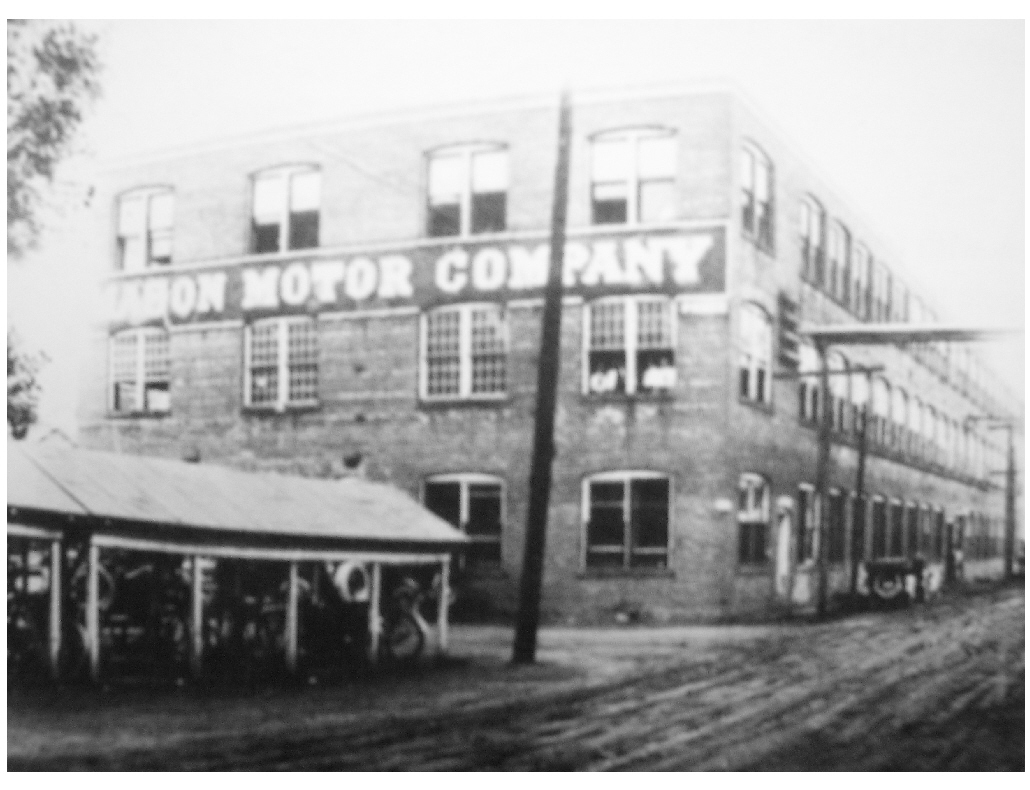
Arthur C, Mason  buys old Buick factory.1913.  

These south facing views of the original Buick factory show it’s location directly across Kearsley Street to the south. The inserted photo shows the expansion done in 1907 (white area). This would be removed in 1915 to make way for the large engine factory expansion from the west. The story above shows that Mason occupied the west end of the Little plant which was originally the Flint wagon Works, so they just moved across the street .   Mason plant from Kearsley Street.
The announcement that Chevrolet bought the property that we all know as “Chevy In The Hole”.


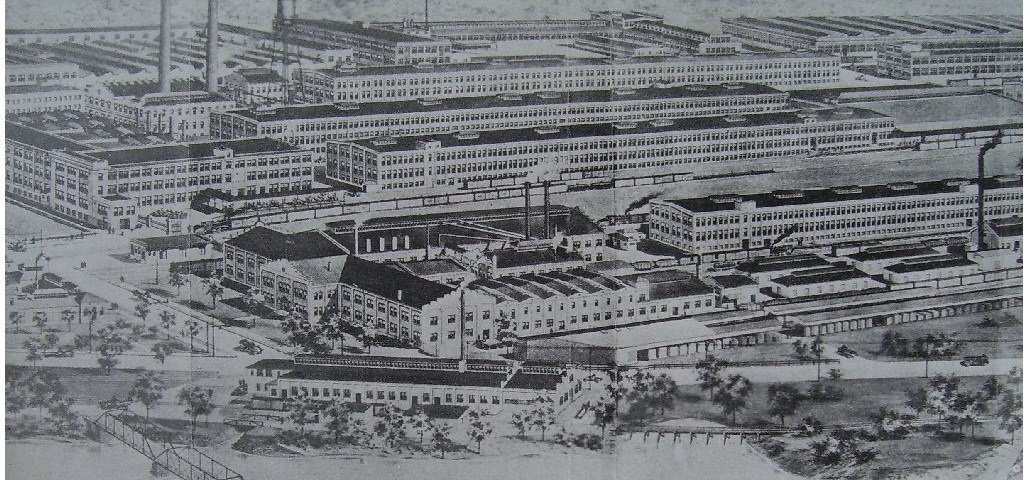
These well know renditions of the Chevrolet plant from 1915 are riddled with things that never were done but were announced and also contain scale problems. Also the amount of windows shown in these drawings are not even close. The top photo  facing north is showing both the old Buick and Mason plant at the left with the old Flint Wagon Works just across kearsley Street. The extension shown on the east end of the old Buick plant was announced but never built. The proportions are not correct and has too many windows. The amount of floors in both drawings are surprisingly correct. The Wagon Works is closer to being correct but the office located at the east end has the wrong amount of windows also. The lower drawing is just showing the old Buick and Mason engine plant looking south across Kearsley Street. As I previously stated the floors are correct but the windows are not. The indented area at mid building is correct and would be removed in 1915 for the factory #4 engine plant extension from the west.  Also the addition shown doubling the plant size to the west was never built. Also the addition to the east ‘that I mentioned earlier’ from the line across the roof east ‘was never built but announced’. 

Chevrolet workers inside the old Flint Wagon Works factory.
This shows construction July 1915 of the new Mason motor factory located just behind ‘or west’ of the original Buick factory on west Kearsley that later became Mason Motors and then Chevrolet.  

New Mason engine factory groundbreaking.
This photo across Wilcox Street (future Chevrolet ave.)  facing east shows the new  Mason engine factory addition  that will become the south annex of the future factory #4 engine plant on Chevrolet Avenue. At this time in 1915 this area was known as “The Home Of The Little Four”. I’m also showing the original Mason factory (in the background) which was before ‘Mason’, the first Buick factory #2  in Flint on west Kearsley Street.  Go here for more on this.

This is engine production  in the south annex of factory #4. I believe this is when it was still a Mason factory. This area is shown in the photo above this one, on the right. The saw tooth roof area is the original Mason factory where this photo was taken. 

Here is an announcement for the engine plant #4 that would be built  connected to the old Mason factory which was where the first Little four engines were built. The assembly plant  mentioned would be factory #2.  

The 1916 Chevrolet expansion news. 

A map of the Chevrolet site along the Flint river. This was made when Delphi took over.
The #3 Parts & Service building which started out life as  a "Central Warehouse" was proposed but not constructed in 1916. The Assembly Plant #2 started it's life very similar to the 'later built'  Buick Unified assembly line, meaning Buick must have most certainly copied this method for saving money on needed floor space. The original construction was U-shaped without the overhead steel and glass roof. The #6 Stamping plant started out as an axle plant. The old Mason engine Plant finally got the big expansion becoming the #4 engine Plant I worked in.
The yellow areas show construction during 1915 to 1916. The blue area is the Mason Motors extension built in early 1915. The brown area shows the part of the Mason plant that would have the roof raised and a peaked roof added. The green area is the engine plant that everyone alive today knows as #4 and was built between 1916 to 1917 and also saw the demolition of the old original Buick plant extension to the west being removed.

Here is factory #6 sheet metal being built in 1918. This view is facing west.. This is the east end of the factory. 

This would be a photo shortly after factory #4 opened in 1917. That is the 490  four cylinder engine on the line. When you enlarge you can see the nice wood flooring installed. In my time the floor was wooden blocks. The mezzanines visible on either side were also done with wood blocks when I was there. The weight limit signs stated maximum weight at 175 lbs per square foot. I have many stories in my memoirs about my short stay here. ‘It was really different and not in a good way’.  


This south-east view shows the actual construction during the 1915 to 1918 expansion of the Chevrolet site.
The same factory #2 assembly as shown below only facing east across Wilcox Street (Chevrolet ave. now). The photographer is standing where Fisher Body 2-a will be built in 1922 to 1923. 
Facing west with the final audit area #21 called the “Cowshed” in the left foreground. Assembly plant #2 is beyond at left. Bluff Street would be beyond the fence at the right. This shows the two factories built between 1915 and 1916 which became the south and north wings of the factory #4 engine plant. The area you notice on the Mason plant that shows a flat roof on the left would be raised and receive a peaked roof. The open area at the right in the Axle and Heat Treat postcard is where the main floor of the engine factory #4 would be built. At that time I believe axle production moved to Detroit.
This shows the two factories built between 1915 and 1916 which became the south and north wings of the factory #4 engine plant. The area you notice on the Mason plant that shows a flat roof on the left would be raised and receive a peaked roof. The open area at the right in the Axle and Heat Treat postcard is where the main floor of the engine factory #4 would be built. At that time I believe axle production moved to Detroit.
A view  in 1915 looking north up Wilcox street before the change to Chevrolet avenue. Notice the bluff here before it was removed for the street to go through. I remember the one lane street that was blocked off that used to go through to Court street in the old days. As a kid that fascinated me. When I lived in downtown Flint in 1981 -82 the property I lived on was about 1 acre and was bounded by 9th , Grand Traverse and  Church street with old 10th street closed off in the back lot. The kids had their own paved street to ride bikes on. Factory #4 engine has not been built yet in this photo

Another view around 1916 just a little later than the one above, looking north up Wilcox street before the change to Chevrolet avenue. The saw tooth roof structure at the right is the old Mason plant which was incorporated into the large  Chevrolet engine plant #4 built between 1916 to 1917.  Original factory.  Mason.


This was actually published Nov 17, 1916.
Winter of 1917 Chevrolet construction.  

Chevrolet absorbs the Mason Company 1918.
News of Chevrolet building the new Fisher Body factory which was  their first factory in Flint. Fisher would lease the building from Chevrolet.  It would be open for business in 1923. Little did anyone know (at the time) that Billy Durant was building future Fisher body factory #1 at the same time.  He was constructing his Durant Star factory on property that once belonged to his master motor builder Arthur C. Mason.  It was located at Masons’s farm located on south Saginaw Street in Flint. After Durant’s stock market losses in 1929 General Motors purchased the Durant factory, ‘thus creating Fisher #1 for the building of Buick body’s’. As with many plant designations attached to the factory’s of General Motors Fisher #1 was actually Fisher #2… ‘if you numbered them by first built’. In the aerial photo shown farther below you now see Fisher body 2-a at the bottom left corner. You will also notice that the Central Parts warehouse #3 ‘that was announced for construction during 1916‘ has now been built (top left). 

This is the kitchen area for the cafeteria shown below. From the looks of everything I would place this in the 1920’s possibly. 

I was told second hand that this cafeteria was located on the second floor of the Fisher body factory #2-a. The worker said he had been in here many times. I wonder if my grandfather ate in here?


This view from the west from the mid 1920’s when General Motors expanded many of it’s factories. This photo now has #7, #8, #9, #5 and Fisher Body #2-a. There is also the support buildings #1, #3, #36.

A collection of Chevrolet plants in the 1920’s.    

Here is a drive-away on  west Kearsley Street in 1921 or 1922. This south facing view shows good detail of these Chevrolet 490’s. Notice the back-lights (round rear windows). These back-lights were mostly used for the 21 through 22 model years. The 1918 Series D used them for one year but these are not one of those.


Here is another factory drive-away getting underway in 1924 with a line of  (low priced) Chevrolet  Touring cars. This view is facing south on west Kearsley Street just east of factory #9. 

Here is a 1924 Chevrolet, only this one is the more expensive Superior Series F Deluxe. Notice the solid steel wheels and a lot of nickle plating. ‘Also notice the building in the background’. That is the south-east corner of the old Flint Wagon Works main office on west Kearsley Street shown on the 1907 map below.

This 1907 map supplied by Leonard Thygesen shows the exact location for the photograph shown above.


By everything I see in this photo ‘including’ licence plates  I would say this is 1925  during a shift change at Chevrolet. When you enlarge this photo you will also notice that the bridge connecting Fisher Body factory #2-a with the assembly factory #2 is showing in large letters “FISHER BODY with their coach logo followed by the Chevrolet bow tie logo and CHEVROLET”. My grandfather was working in 2-a at this time.  Go here for a 1937 view of the bridge.  

This automobile is the ‘new’ Superior  Series K  for 1925. Notice that the spare tire was an extra charge option then. The car in front of it is just a cowl and Chassis that would be getting a special built body from one of the many independent body builders at that time. This east view has the cars ready to enter the area known as the cow shed.

Final line 1925.
Here is a whole group of 1925 K cars heading south on Saginaw street through downtown Flint. The stickers on the windshields say “It’s easy to pay for a Chevrolet”. Price was the main selling point in 1925 for Chevrolet. These cars are different than the ones produced later in the model run because they do not have a cross brace between the headlights.

I do not have enough knowledge and clarity of this photo to make a best guess as to the year other than before World War II because we only have the one original smoke stack on the #11 powerhouse. The second stack would be built just following the war and would not have the word CHEVROLET built into it’s brick work. The numbers in the lower right corner are a mystery to me. I somewhat figured out the ones taken at Buick but these appear to have been cropped. I can see that the familiar stairs at the entrance to factory #4 on the right are now in place. The bus off to the right just beyond factory #4 appears to be from Yellow Coach
Facing east directly in front of the main gate to factory #4. This looks like maybe a union representative passing out leaflets to the workers during a shift change.
Here were looking across the Flint river that is being crossed by a drive-away of 1925 Chevrolet’s. The Powerhouse #11 is on the left with factory #2 and the audit area on the right. 


After close study I think these are 1927 Chevrolet’s heading east in factory #2. ‘Trucks on the north line and cars on the south line’. On the car line I see what appears to be (what was then called) an LM Series 1 ton truck or what we would later just call a pickup

This 1927 view across the Flint river shows great detail of the final audit area called the cow shed. Of coarse that is factory #2 assembly directly west behind that area. The powerhouse #11 is off to the left with the large smoke stack. This photo was taken from just outside of the sheet metal factory #6. 

Facing south from Bluff Street with factory #6, #7, #8 and #4.
These 1927 Chevrolet’s are just coming off the double assembly line and entering the final audit area called the cow shed by the workers.
 
Sloan just entering the passenger  side of the best selling Chevrolet for the 1927 model year.  This is the Capital Series AA 2-door Coach. That is factory #6 in the background.
Some students taking a break for a photo op on May 2, 1928.


This is William (Bunkie) Knudsen  congratulating Alfred P. Sloan in front of the 4 millionth Chevrolet. I have many photos with Sloan in them but he was and still is not very well liked by union men. Some of the old sit-down strikers would not set a foot inside the Sloan museum in Flint because of his name associated with it. This area located at the east end of factory #2 was called the  “Cow shed”. ‘If anybody knows why please let us know’. This is facing south-west.
Plant manager Charles F. Barth on the left and G.M. President William Knudsen with the 4 millionth Chevrolet. This north-east view shows a piece of factory #6 across the Flint river at the right.
The same as above only more suits in attendance. Notice the steam engine in the background. This view is facing north-east from behind the assembly plant #2. On the bluff in the distance lined with homes is obviously ‘Bluff street’.
 
Add caption

Here is the 5 millionth Chevrolet coming off the final line in the addition with the saw-tooth  roof called the “Cow shed” in factory #2. This is a west view in 1928.  

Here is a marshaling area for a one day drive-away of every kind of Chevrolet truck built in 1931. This is in front of the I.M.A. auditorium in down town Flint. This view is facing south-east with the Flint river in the background. The building in the distance beyond Athletic Park is The Ohio Plate Glass warehouse. That would be where all the automobile glass would have been distributed to all the Fisher Body plants in Flint. this is May 5, 1931.

The photo with all the 1950 Buick’s is the exact same view and location as the previous photo of the Chevrolet trucks in 1931.  

When you enlarge this photo you will see a 1933 licence plate. The person in front of the gate in the white suit and paper hat is  selling the Flint Journal. This entrance is for the engine factory #4.  I myself  climbed these same stairs many times when I was laid-off from Buick . This first  addition, of the first modern factory built here was originally built for Mason Motors just to the south but connected. It had a saw-tooth roof.
These skilled tradesman appear to be wrestling a large lower half of a fender die into this press. I’m not sure of the year but by the looks of the fender die it is a front fender for a 30’s automobile. This is in factory #10. ‘I say it is being installed because it is spotless’.

I originally thought this was factory #7 judging by the height of the roof. But I’m thinking it is #10 at this time. I wish I had worked here longer and explored a little more. ‘Probably not though‘. If anyone has better information let me know.  Go here for a youtube video that actually shows the Chevrolet plant in Flint Michigan during 1936.


Here is a 1934 Master Series Sports Sedan just receiving it’s body. This is a north view in factory #2.

Here is a 1935 radiator being installed in factory #2. The 1935 model year was the last grill that still had  an area that  that was made for the old style engine crank. This was kept on many cars until management felt secure with the electric self starter.

This finished 1935 is just getting it’s final inspection in the cow shed. This Standard Coach was Chevrolet’s most popular model that year. You can tell these from the other models by the three ribs pressed into the side apron of the hood. This particular car had some extra features like deluxe bumper guards and costly side mount spare tire.   

First off I see a 1934 Oldsmobile against the curb in front of factory #4 at the left. I also see two different  style and color  licence plates. I’m thinking the the car at  the left is wearing it’s 1936 plates while a couple of other vehicles are wearing  the 1937 plate. At this time automobile plates had to be purchased by February 31st, which if  I’ve correctly deduced this, that would place this photo at least before February 31, 1936. I do see the two different styles and colors on more than one vehicle here. ‘I spent way to much time with this one but I learned a lot of licence plate history that could come in handy in the future’.  After all that, we are looking south on Chevrolet Avenue with factory #4 on the left with factory #5 on the right. Factory #5 has to hold the record as the dirtiest factory I ever worked in. As I have said before ‘the local contract here was such that everybody worked a job including the President of the local’. I needed to see my shop committee man once and his job was cutting bearing caps near the back of factory #5. Just walking through this factory would leave you covered with filth. When I worked overtime in there you really learned what being dirty was all about. 

Labeled as a CHEVROLET FAMILY PARTY  in 1936, I would be suspect as to whether  this was a mandatory affair for propaganda purposes or really a party.  ‘This does not look like a party to me‘. Where is the food and cake? Do you see any happy faces? Is there any dancing or socializing? Could it be our ancestors did not know how to have a party? ‘I think not‘. The sit-down strike was only months away at this time. Buick used to have these kind of  “PARTYS” at Whiting auditorium when I worked there and they looked just like this. Everybody just sitting in their chairs listening to the company tell me how great the Japanese were and that we had better wake up.  When you enlarge this photo look for all the police standing in every aisle way. ‘I’m  sorry but I just don’t see the party in this photo’. Looks like they did get a full house though. I have seen so much entertainment in this place over the years ranging from the Shrine  Circus to wrestling…Johnny Ginger and Soupy Sales. I seen the three Ali Fraser fights on closed circuit here. I was there to see the IMAX. theater for Auto World. And of coarse I seen many rock concerts here. I seen Alice Cooper shot out of a cannon and then hung on a gallows. Maybe someone will remember the pair of Klipsch La scala  speaker horns above the stage. My bass player bought a set in the 70’s and they were pretty great. These speakers were so good that they have never changed them since they were first introduced in the 1930’s. I’ll bet they crashed down with the rest of the building when it was imploded. I’ve always missed this place. This is where I saw the original Batmobile which recently sold for $4 and a half million dollars. ‘Where was Batman and Robin when we needed them’? 


National guardsmen aiming what looks to be a teargas grenade launcher on the entrance to factory #4. This photo from the 1937 sit down strike was taken from the Grand Trunk rail crossing on Chevrolet Avenue facing north.
The morning after the “Running Of The Bulls”. This is facing north on Chevrolet Avenue from the bridge over the Flint river.
                                                                    
Here are some photos showing the Woman’s Brigade during the 37 strike.
Here is the Woman’s Brigade in action shortly after police let loose the tear gas in factory #9.
The photographers flash powder lights the scene under the body bridge just before the violence erupted between the Bull’s and the strikers.        
The police Chiefs car is being overturned during the running of the bulls. This happened under the bridge from Fisher Body to the assembly plant which is shown farther below. This was one of the reasons that the Governor sent in the troops.   
The national guard on patrol on west Kearsley Street near Chevrolet.
The National Guard setting up their gun at the top of the hill on Chevrolet Avenue at the crossing of the Grand Trunk rail line.
Support arrives with the  union leaders and their sound car.
Removing an injured worker during the strike.
This is looking east along Kearsley Street during the Sit-down strike. This was before the National Guard was sent into Flint to protect the strikers from the police chief and his goons. Notice the broken windows where the Woman’s brigade let fresh air in so their husbands, fathers and sons could breath. ‘I would have loved to have been an active participant during this time’. Buick workers were kept at bay by goon squads right in the factory with baseball bats. That is why they were left sitting  ‘excuse the pun‘ on the sidelines. Another thing worth noting is that the Chevrolet workers were mostly from the southern United States and were already use to mine strikes and the brutality that went along with them. The Buick workers were mostly immigrants that were more easily intimidated back then. It is hard watching the Great Grandchildren of these brave union men now being betrayed by their ancestors. Sorry about the rant but sometimes my political views creep in here. I have always had friends in management but we always knew if “push came to shove” where our loyalties would lie.
The National guard arrive. This view is facing north at the  spot where the “Running of the Bulls”  took place.  Click here for a history lesson.
Truck crossing the Chevrolet and Grand Trunk rail crossing.  

In front of factory #4 gate.
Cleaning up after the “running bulls” incident. 

This would be the location from where the hinges were thrown  during the 1937 strike. . This would be Fisher Body #2-a. This view is probably facing north with Chevrolet Avenue just to the right. The bridge crossing Chevrolet Avenue would be just to the right of the photographer. 


Letting in some fresh air after the teargas attack by Flint police.
The National Guard protecting the area  where the teargas was  released by the Flint police who were under orders of injunction by Judge Edward Black who was a large holder of General Motors stock. 
The woman’s brigade marching in solidarity of the strikers inside. This is factory #9 on Kearsley Street.
This is the location of the National Guardsmen encampment  while they were in Flint during the Sit down strike of 1937. This is the old Flint High school on the location of the parking ramp that was built for the old Montgomery store in downtown Flint. This building is now used for the 67th district court in Flint and the parking structure is still there. One side note is Billy Durant almost graduated from this school. He quit to seek his fortunes in life. His mothers home was just across the street.  Click here for that history.
These National Guard troops are marching east on Glenwood Avenue  at the intersection  of Chevrolet Avenue During the 1937 Sit-down strike. We were lucky at that time to have had a Governor (Frank Murphy) send in these men to protect the strikers. Can you imagine what life would have been like with  Governor Rick Snyder and his union busting crew back then? 

Flint Color Photos Supplied From The Weaver Family

The end of the Sit Down strike.


This is the body drop or body marriage ‘whichever you prefer’ in factory #2 looking west up the assembly line.  The year is 1938.  To see this in action go here.  

Notice the Buick body trucks being used as bleachers. Also notice the Buick retail store in the background. This is just north of the Durant Hotel on North Saginaw Street. This is the third annual Motor Parade in Flint.
This one is only identified as grilles being made in Flint. The only match I can find would make this a 1938 grille.

This truck roof being smoothed out could possibly be for a one and a half ton truck.


You can’t swing a dead cat without hitting a suit in this photo. This is the final inspection area of factory #2. The event is the 25 millionth Chevrolet. We have G.M. President William Knudsen speaking and Chevrolet General Manager Marvin Coyle leaning on the car. Alfred Sloan is at Knudsen’s left and then on Sloan’s left is “Smiling” Charley Wilson. The tall gentleman next to the passenger side fender with his hand in his pocket is Charles Stewart Mott. William Durant’s last public recognition from General Motors was at the banquet in Detroit on January 11,1940

In the right  foreground is a 1939 Chevrolet Town Sedan just getting ready to enter the executive garage #21 that is located just behind and attached to the main office #1 on Chevrolet Avenue. ‘No way this was just used for executive vehicles’ as shown in the photo above this one.  The building on the left is #3 Parts and Service. In this east facing view taken from the main office you can just see over the roof of the garage  the final assembly plant #2. The bluff of Bluff Street is visible in the distance, the bend in the Flint river is also visible near Atwood stadium. Parts and Service is located on Bluff Street.
This photo is showing the interior of Chevrolet’s garage #21 ‘shown farther below at the right’. As you see this is the dust jacket from “The American Auto Factory”. I first seen this book at “The Genesee County Historical Society” Located in the old Durant Dort office on west Water Street in Flint.  Follow the link above to see that exact book covered in broken glass, from an attack by vandals. It is the last one in the case shown. 

I did find another photo inside the garage #21 only this one is from 1941. This almost reminds me of the inspection floor and repair floor from Buick because I see some parts are added right in the garage like the headlight bezels shown stacked on the workers table and in the box. Were definitely seeing Deluxe models but I can’t see enough detail to pick which in the Deluxe lineup.

The car in the foreground is a 1941 Special Deluxe Town Sedan heading east in factory #2 in Flint, Michigan.

Here is the last Chevrolet off the line in 1942. This photo is reminiscent of the more well known Buick photo depicting this milestone event. 

Chevrolet presses sitting in the weather during the rush to change over to war production in World War II. 


The floor plan for Fisher Body #2-a in 1944 while doing war work. This diagram would have the first and second floors with north being at the top. Chevrolet Avenue would be at the right with the Flint river along the bottom. Compare the office area kick-out and rail line with the photo below for your reference points. Notice the 49 foot kick-out at the north west corner on the diagram of the second floor (at top) and compare that with the photo below and you will see where the major addition was done along the entire 900 foot length of the north wall of #2-a.  The 90 mm gun work  done here would have had final assembly across town at the Buick factory. Follow this link for a look at that work.  Follow this link for a look at the Pratt & Whitney assembly location at the Buick Melrose factory near Chicago.  The armored car assembly was done directly across the street from here in factory #2 as shown in the following photos. Chevrolet engines built here during the war were used in many different vehicles. 
Notice the kick-out of the office area to the south on Chevrolet Avenue at the top right and compare that with the diagram above. Also notice the rail line as your reference point. The Flint river is where the tree line is at the right. This photo from after the war shows a major addition on the north side of the factory. The 49 foot extension to the west rear of the factory was on the second floor only (compare that with the diagram shown above).
Turret assembly for the armored car called the Staghound. This is in one of the two annexes of factory #2 assembly.
Finished armored car in the audit area known as the Cow shed  getting finishing touches.
The armored car on the assembly line in factory #2 assembly in World War II.
A 37mm main gun is on this armored car called a ‘Staghound’. These were built in  Chevrolet factory #2 in Flint, Michigan, 


Here is the assembly line in Chevrolet factory #2 during World War 2. This is the armored car shown above being built.
The Personnel building being built on Kearsley Street. Not sure of a date yet other than before World War II.
Here are newly laid off workers in 1942 outside the personnel building on Kearsley street. They are only laid off while changeover is done for war production.  

This Chevrolet Personnel building which was the first purposely built one, is on west Kearsley street where the old Flint Wagon Works was once located. This spot would be directly north across the street from the first Buick plant if it were still there at this time. Factory #9 is barley visible at the right. That is the factory where the woman’s brigade were breaking windows so the sit-downers could get some air after the police released tear gas on them.  I myself hired in at a more modern glass covered building that also housed the hospital over on Bluff street. I have a photo showing #36 personnel and hospital but it does not appear to be the same even though it is in the right spot. ‘After all these years it could very well be that I remember it wrong’.


This is some hood stamping going on in factory #6 which is shown in the previous two photos above. These look like the separate hood segments being produced during World War II  and post war trucks for the military half ton which even included an early Suburban model. The post war models were identical. Click here for a view of the Suburban split hood.


This is after World War II because there is now two smoke stacks on the #11 powerhouse.  Go here for Thomas Wirt photos.
Management in front of the main office on Chevrolet Avenue. This building was numbered #1 and we are facing east with the corner of Bluff Avenue at the north end. 
Looking north at the intersection of Bluff and Cadillac street. This is the haul-away  area for new cars. That is G.M.I. (Kettering now) University at the corner of Chevrolet and Third Avenue which is University Drive now. This photo was taken from building #3.
Office workers at quitting time. That is the main office behind them on Chevrolet Avenue. This is facing north. 

This photo taken from the Chevrolet Avenue bridge facing north shows first the powerhouse #11  across the river with factory #2 beyond. Click here for the commemorative Flint Journal book on the flood

This east facing view taken from factory #2-a shows the main office #1 with the attached garage #21 (shown farther above) and factory #2 on the right. Click here for the commemorative Flint Journal book on the flood

The inside of factory #2 during the 1947 flood. This may be during the move to the new assembly plant on VanSlyke Road. I say that because of all the crated stuff. Click here for the commemorative Flint Journal book on the flood

Looking south on Chevrolet Avenue during the 1947 flood. I could still see the high water mark in factory #4 when I worked there. Factory #2 is on the left with #2-a on the right. The large chimney or smoke stack is from the powerhouse #11. Factory #4 is beyond the river on the left  where you can see the car flooded out on the bridge. Factory #5 is across from that.  Click here for the commemorative Flint Journal book on the flood

Same as above.    Click here for more factory flood photos.

Facing east towards downtown during the flood. Click here for yet more factory flood photos.

Factory #2 after the assembly line had been removed in 1947.  It is now a die makers paradise.  

A production record set at the Flint assembly plant on Van Slyke Road.

My family was in downtown Flint when this car went up Saginaw Street during the celebration. Go here for some more on this celebration.

Harlow Curtice with the 50 millionth General Motors car coming  off the assembly line  at the  assembly plant on Van Slyke Road in Flint Shown farther below.  

Here is the final line at the Van Slyke road assembly plant.  

The Van Slyke road assembly plant in 1959.
A very small group of pickets outside of factory #2. This photo was taken from factory #2-a across Chevrolet Avenue.

This view is facing north on Chevrolet Avenue. An astute reader noticed that I made a mistake concerning the intersection which the motorcycle cop is crossing. It is actually the Grand Trunk rail crossing. I grew up Chev/Glenwood neighborhood you make a GREAT blog. The cop on cycle in 1936 chev. ave by liberty bell bar is not at intersection of Glenwood and Chevrolet ave. he is at RR track.  ‘Thanks go out to Sharon McCrory’. Beyond that on the left just down the hill is factory #5. The bow tie Chevrolet emblem that most people remember driving under that is mounted on the bridge from factory 2-a to #2 is now out front of the Vic Canaver dealership on Owen Road in Fenton, Michigan just south of Flint. This photo would be at least after 1961 because “you guessed it’!  a 1961 Chevrolet  Biscayne Utility sedan parked in the foreground.  This incidentally was the first car I ever owned when I was fourteen years old.  It had been painted light blue with a brush. My brother bought it for me to try and keep me out of trouble by getting it running and restoring it. He also thought I should enter it in competition at Tri City DragWay saying it would be rather easy to win in my class, ‘what with the six cylinder and all’. I never liked driving fast so that never worked out. I lived with my brother from age 13 to 16 at which time  my probation officer made me move in with my mother and stepfather whom the latter liked to drink and knock me around. Luckily I got released from probation within three months and  moved back with my brother. I actually only got beat up twice during that period and gave as good as I got in one fight with the help of an old fashioned iron pancake skillet. By the way I did get the straight “stove bolt six” running and re-covered the door panels in black and blue vinyl. I never did get to drive it legally on the road though. Back then I would cut my cars up when I was through with them. In this particular car I found a 7-up can had been sealed in the firewall at the factory. I read about this happening years later and that workers would put a note in the can saying “you finally found me” meaning the hidden rattle knowbody could ever find. I never looked for a note but did ponder it’s placement for some time. My next car was a 1961 Sport sedan that ended up with the front sheet-metal from my 1962 Chevy Impala. The main difference besides price between the utility version and sport sedan was the roof line. I’ve never looked back and still work on old Chevy’s and my Buick.


This south facing view shows  Chevrolet #3 Parts and Service at Mathewson & Bluff Street. Go here for a discussion on this photo from the Flint Expatriate site from a few years back. 
Here is an identification card for Doris Wright who once worked here.
This machine is forming flat steel into exhaust pipe.
This photo was just labeled as factory  #2 by David White at Kettering University but he has made so many obvious errors since I first encountered his published works in 1985 it is actually anybody’s guess. I was never in factory #2 so I have no personal knowledge. The cement ceiling configuration certainly does not look like any I have seen from confirmed factory #2 annex photos. Maybe someone will recognize it. Whatever the ladies are assembling seems to require three different wires.  I know it would seem strange to have a part that seems like it should be made at A.C. being built in the final assembly plant. But I am reminded of when I worked in factory #4 on the six line and the machines that made the head bolts was only 20 feet away.
Metal stamping in factory #8.
Chevy Metal Fab.
Chevy Metal Fab.
Chevy Metal Fab. On Bristol Road in Flint, Michigan.
Labeled as piston molding. That is all I know.
This view was taken from the south bank of the Flint river just east of the Chevrolet bridge. The #11 powerhouse is on the left with factory #2 in the background.  The small building is #29 ( I’m not sure of it’s purpose) and the rather small two story  brick structure was #13 maintenance.
Here is the powerhouse #11 with factory #2 directly north.
A nice view of #11 during demolition.
These three color photos  taken by Mary Dugas are from a Leonard Thygesen  documentary on the demolition at the Chevrolet site. To contact Leonard  Click here.
This looks like when I worked in factory #4 . ‘This worker looks familiar’. I originally thought this was the north annex of #4 but I do not remember ever seeing those large round pillars (shown behind the crank line) if anyone knows give a shout. They did do work like this in #4 when I was there.  I’m not sure but this looks like he is doing a rough grind here.
Making gas tanks in factory #10.
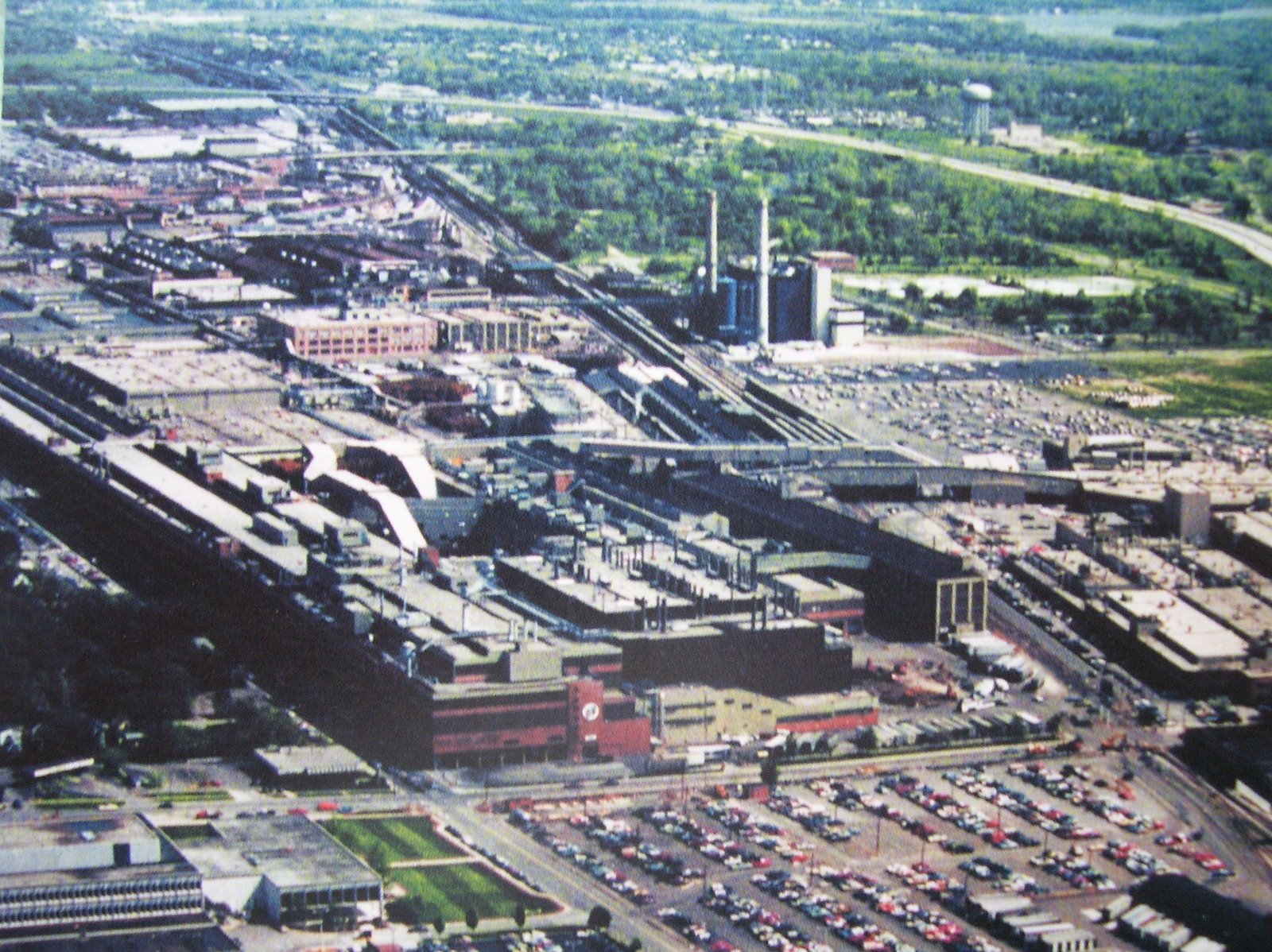
This photo is sometime shortly after 1974 judging by the newly remodeled Freightliner  tractor backed into the dock just beyond the vehicle bridge across the Flint river. ‘This is when I worked here’. Factory #2 at the right is I believe a die and stamping plant at that time. I recall they were making bumpers here then. The powerhouse has now received a new smoke stack. The book this came from stated the large silos at the left held plastic pellets, so there must have been an injection molding facility nearby for plastic parts. Further research is required. Notice only one smoke stack visible on the powerhouse #11. The photographer just so happened to be lined up so the west stack is hidden by the original east stack.
The drafting department in an annex of factory #2. Notice the pillars and ceiling. This is how both of the north and south annexes would have been. 
Here are V8 engine blocks being machined in factory #5. The engine blocks made their way to the assembly plant #4 across Chevrolet Avenue by way of a tunnel under the street. ‘This was a very dirty place to work’.
This is an open house in 1970. The view is facing east along the south wall of factory #6. This particular area with the vented roof structure was not part of the original factory and was added at a later time. The long wall with no windows which originally had them (see the photo below showing the exact same view from 1928) is part of the original factory and also has a vented roof structure, only running opposite to this one. The overhead steam lines are connected to factory #7 which was the stores and maintenance factory and also included the dynomometer engine test facility at this time  but historically was a pressed metal plant. The placard placed inside the bus windshield says Bluff Street but it looks like they entered from Stevenson Street. The placards have probably already been changed and the bus will cross the bridge (just out of site in this photo to the left)  across the Flint river and then on to Bluff.  The banners read “Chevrolet Flint MFG. Pressed Metal Div. Welcomes You To Our Open House”.
This north view of factory #6 is from 1928 and shows some of the workers. Look at the photo above for the 1970 view of this area.
This night view from 1937  taken from the north side of the Flint river shows first factory #6 followed by #7 and finally #8.
Clutch springs being inspected in factory #8.                                                       
This north-east view counting factory’s from the right we have first #8 then #7 followed by #6 at the far left which was the first built in this group. The location of #8 and #7 is the historical location of the Flint Wagon Works on west Kearsley Street. The Flint river is at the left.
Making fans in factory #8.
Grinding valves in factory #9. I worked overtime in this factory gauging finished valves.
Shells being made during World War II. I’m not sure of the factory or even if this is in Flint. The book from Kettering says this is factory #2 but as I’ve said you can’t trust the author and his  books or maybe he just does not do the research himself. I’ve had the same problem with the Buick archives stored in the Buick Research center in Flint. Someone back in the early seventy’s had labeled many of the photos wrong. If your a researcher always be suspect of all information anywhere.’Do your own work’!  You really need to take the time to do it yourself or you run the risk of perpetuating wrong information. This happens quite often with reporters and authors who have a deadline to make. The old trade journals also have questionable information even though it was done at the time of the incident. All I can stress is: ‘Be Careful’. ‘We all make mistakes’. 
Engine painting in factory #4. This is the same as shown below. When I worked here the engines were all pulled off the line and hooked up to fuel and water and started just before reaching paint. At least every half hour or so you could hear one that was a failure.
This looks the same as when I was in factory #4. In my time the V8’s were Chevrolet red (orange) with the six cylinder blue.
Here is piston installation in factory #4. Notice in the background there is a parallel six cylinder line. In my time that was a V8 line. 
This is the same job I first did in factory #4. The only difference is when I did it I also had a multiple air wrench for tightening the valve cover. I also placed the rubber oil filler plug in place. We did 165 per hour in an 8 hour shift with a twenty minute paid lunch and 16 minute pre- lunch break and a 10 minute after lunch break. The line run 24 hours a day. We did have a nice cafeteria but you only had time to visit it if your break would happen to coincide with your 20 minute lunch. I really hated working at Chevrolet. Thank goodness Buick called me back after 9 months. Then I transferred for 5 years to Bay City Powertrain. I found out they had it better than all the places I had worked before. ‘Working the machine floor was the way to go’ At Buick you needed many years for that privilege.   Click here for comparisons between Buick and Chevy.
This is the office for Chevrolet assembly on Van Slyke Road.  This view is facing west. It is located south-west of the first Chevrolet assembly #2 at the Chevy site on the Flint River. This is 1947. This factory is one of the few still working in Flint and is the only one that actually assembles a vehicle. What a change from my time.
This shows Robert Gathman  on the left and then General Motors President Pete Estes with the first Lordstown ,Ohio Chevrolet in 1965. My car is almost identical to this one except mine has a vinyl top.   Go here for photos of my car   during restoration.   
This is my 1966 Chevrolet Caprice. This car was built September 23, 1965 and was #344 built at the factory shown below.
This is the assembly plant where my 1966 Chevrolet was built in September 1965. This  is a west  view. The office shown farther above is the first structure you see in the foreground. This was a combination Fisher Body and assembly plant. After this plant opened the two factory’s #02 and #02-a at the old Chevrolet Avenue site were converted to stamping plants. This is now Chevrolet truck assembly. The last car, A Monte Carlo came off the line here  June 24, 1970. The first Corvette would be built here in 1953 in the building off to the right.  Go here for a video of my trip with my Chevy to this factory.

Looking west up old Torrey Road with VanSlyke off to the left heading south. Torrey would become 12th Street after the I-69 freeway was built. That is I-69 at the right. The factory off to the top left is the Chevrolet assembly plant shown above.
A 1940 map showing the old route of Torrey road as I remember it as a small child. My mother had her best friend living where the I-69 freeway is in the photo below. The red box is where the future chevrolet Manufacturing will be built in 1947. The green line is the approximate route of future I-69 and the blue line is the I-75 built in 1957. North is at the top.
This camshaft polisher does basically the same thing as the one I used at Bay City Powertrain. The main differences with all the advances in technology  was mine being the size of a semi truck and trailer. These polishing sand paper rolls are the size of many we tossed away because we turned out so many that management did not want the machine shut down very often for changing a few rolls. ‘We would instead normally change them all at once’. I have some of these small rolls that I kept from the trash and use them quite often. I use old lottery ticket dispensers that my wife brought home from the trash where she worked  and they work great for dispensing the correct amount needed.. ‘One mans trash is another’s treasure’. 
Here is a valve grinder. When I would work overtime I would go to plant #9 usually where these strange looking tracks would run throughout the factory like an out of control model railroad. Notice that the track enters the machine at the top left and continues directly out of the front. I never run any machines and just gauged them.  


Barker & Hamel and the 1904 flood

Notice the trees with leaves through the window. These trees are shown farther below in the photo showing the back wall of this foundry. This photo is dated April 22, 1904. Robert Wilmont Harrison is the one with no hat on the left. I truly believe that the 1904 Flint flood was the main reason that the Buick company got into financial trouble and that this was the catalyst that would bring William Durant into the fold and that led to the creation of General Motors. If you think about it the Buick vs. Reid lawsuit has David Buick stating ‘fact’ that the flood was what kept the engines from being produced on time. David Buick told the Wolverine Citizen that they were planning on building 300 automobiles in 1904 and we now know that only thirty seven were produced. Every factory along the river that produced parts for Buick had flood damage and had to be cleaned and repaired. The only main component factory that was not effected was Weston-Mott which built the front and rear axle, and that is because they were still located in New York. The Armstrong spring plant near Oak Park was flooded. The Imperial Wheel plant was flooded. The foundry that supplied brass parts was flooded. Barker & Hamel, who cast the main engine parts was flooded. W.F. Stewart who made the body’s, also flooded. If this act of mother nature had not occurred we may not have General Motors today. We may not have had them making parts for WWI or WWII. The world could be a much different place today if not for one simple flood in the year 1904 in Michigan.   Click here for an alternate history from 1925 that shows December 1903 as the first Buick built.  Buick engines through history.    Buick milestone dates from 1928.  Buick 20th anniversary dates.  More Buick history.   The early years.
An upper case for an early Buick engine for a Buick automobile in Flint. This is not a 1904 case. The original 1904 top case did not have the oil lines routed through the top. It also did not have the F 18 cast into them.  Manuals and literature.
The lower case (crank box) of the first Buick automobile engine for a Buick in Flint.
This photo shows the back wall of the Barker & Hamel foundry at the left. The trees are visible through the window in the photo above. The water is quite high in this photo but not yet at a dangerous flood stage.
Here is the flywheel blueprint done by Eugene C. Richard on September 24,1903. This is not the flywheel for the L-head engine for the Wolverine automobile. It does look like one stationary Buick engine I have seen.  I have found two sources that claim the first Buick car was assembled in December 1903. One also stated that it took until June when “The bugs on this experimental car were killed”. Take it for what you will but every time I close one door another opens on this elusive search. This document has an interesting story which you can read about in the book David Buick’s Marvelous Motor Car by Gustin and Kirbitz and is available at Amazon.
For business reasons Durant did not want this first proper Buick engine patented.
Walter Marr with the Chainless Wolverine prototype shortly before he returned to Buick in January of 1904. This is from the Buick book Buick’s First Half-Century. This is the automobile mentioned in the post previous to this that I said was called the first Buick prototype for many years until someone noticed the differential was for a drive shaft . After that it was obvious that it was the Wolverine by the Reid company  As I mentioned a few years back, Buick and Marr would have both probably had knowledge of this prototype and their Buick model B could very well have been modeled after this. Just like I mention farther below ‘many ideas were probably borrowed between the two company’s. All through history this has been done with most any product on the market. ‘It’s not an accident’.
A 1904 Buick being built.  A view inside the Flint Wagon Works in 1913.
The recreation of the first Buick. Built as a project of the 1976 United States bicentennial.   1904 manual.   History.  Specifications 1904 Buick.  Oldest surviving Buick’s.  Original Aldrich Buick.  1904 Buick prototype. 1905 model C restoration.  More 1904 history.   The Sloan Bicentennial project Buick.
This is Eugene C. Richard the first person with  the foresight to patent the valve in head engine which he said he had taken the idea from his native country of France. This valve arrangement was being used in steam engines at  that time.
Here is the Richard patent application after it had been accepted. This would be for the engine below and of special note is the detachable head just like the later Reid engine. This really makes me wonder.
Here is the patented Eugene C. Richard engine (the patent had been filed but not approved at this time) that had the valve in head design on this one cylinder stationary engine.  Model B stationary engine.  
As you see, the main difference with the ‘Reid built’ over head valve engine is that it had detachable heads, which the Buick 2 cylinder over head engine of 1904 did not have. But engineer Eugene C. Richard who was working closer with Buick than Walter L. Marr when they first arrived in Flint makes me think that some kind of crossover of information had been taking place. You must know that Walter Marr was working for Reid up until January of 1904.  Buick overhead valve head.
End view of the Reid built engine showing great detail of their valve in head arrangement.
This is the engine that Reid had designed and placed in the Chainless Wolverine after  the Buick Co. was late in delivering there L-head  engines, which led to the 1907 lawsuit mentioned in the following post. I find it very interesting that this engine is so similar to the engine that Buick would use in it’s first Flint built Buick. The only difference I see is two carburetters and most importantly is the valve in head arrangement. Kevin Kirbitz says that a photographer was sent to the Flint plant for a photo op and I think someone may have seen more than they should have. Either way the similarity is apparent but just as with today’s engines, “one looks just like another”.
Here is the original photo of the one shown below (that the Buick photographic department cleaned up)  showing the push rod lifter bosses cast into the lower case when they were obviously not needed for this engine. It makes me think that Buick was planning ahead already for a valve in head engine that would make it’s appearance very soon.  This photo is from  David Buick’s Marvelous Motor Car by: Gustin and Kirbitz.  This is the only known photo of this engine.


This photo from the Buick’s First Half-Century (same as above only retouched) supposedly  shows the first Buick engine made in Flint Michigan.  This is the L-head engine being built for sale to the Reid Manufacturing Company mentioned below and in the previous post.


Here is a 1904 Buick engine for comparison to the Reid engine.
This 1904 Buick engine (same as above) shows the cast in boss for the push rods lifter (red arrow). The  L-head Buick engine that was sold to the Reid  Manufacturing company shows the same boss in place  only staggered onto the opposite side. The holes on the top case are the oil holes for a 1905 engine. This engine could very well be a hybrid  of the 1904 engine which has these in the lower case.
Here is the Hamilton Mills mentioned in the photo at the bottom. This is a good view of the new rail bridge crossing the river with the loaded cars for weight. The Copeman building in the background was an old Durant Dort factory but was now run by Dallas Dort only. Another bad flood struck in 1917 and again in 1947. I have photos of those also but they are not relevant to this story.    Click here for the complete Wolverine Citizen story about the 1904 flood.
Here you can see were looking east up Water street with Durant Dort factory #1 on the right which is still in place in downtown Flint, or what is now referred to as “Carriage Town”. That is the bridge mentioned in the photo below. My mother lived on the corner of Water and Lyon directly across from this bridge.
This is the collapse on the east wall of the  Durant Dort factory #1 where the photographer was standing ‘on the roof” while taking the photo below. This was the blacksmiths area as denoted by the numerous smock stacks built directly into the wall. The Durant Dort #2 on Richfield rd. had the same feature and also the Flint Wagon Works on west Kearsley. As you can see they were also storing many wagon wheels here. This photo was taken from the Iron truss bridge on Water Street. This bridge was also known as the Durant Dort bridge and is the one I myself mention in the last post as crossing many times in my youth.
The yellow arrow shows the roof structure of the Barker & Hamel foundry during the 1904 flood (you can enlarge all these photos). The blue arrow shows the  smoke stack. The red arrow shows the false front which was very common on buildings from this era. This photo was taken from the roof of the Durant Dort factory #1 facing east. As you can see the flood waters at this time are three streets south into down town Flint. That is the Crystal Hotel at the extreme right. Directly straight ahead in the distance is the tower of The Grand Trunk depot. The tall structure in the distance at the left is The Hamilton Mills (shown above) on the south side of the river which is directly east of the new Pere Marquette iron truss bridge crossing the Flint river  just east of Saginaw street. If you enlarge you can even see the area painted white on the false front where the name of the company would be. A small portion of that is visible on Jeff Harrisons photo of the workmen standing in front.   Just click here for a large view. 

Barker & Hamel

If the history which has passed down through Jeff Harrison’s four generations is correct,  we are seeing the first Flint built Buick engine,  for the first Flint built Buick automobile, being cast in April of 1904. The reason the previous sentence sounds redundant is because in the beginning Buick was making engines only for farmers, other car builders and also marine engines. This is what was done by Buick in Detroit and continued when they first came to Flint. The decision  to make an automobile came later. In the photo above Robert Wilmont Harrison is at the left with no hat. Jeff said  the notation on the back of this photo  says: first Buick upper and lower case  being poured. He also mentions numbers on the back:  10-6.  I do not know what 10-6 is. My first guess would be some type of model number but I can find no number matching this. If it were a date you would think it would also include the year. And if it were the date, it would be too late in 1904 to be the milestone first engine of the first Flint Buick. Also consider that history shows Barker & Hamel not starting until January of 1904 and the first Buick auto was ‘running around’ the Buick factory in late May of 1904.  It would be easy to say it’s not a date, but it could very well be one. Lets just say for a minute that it is a date,  and 10 is October and 6 is the day, then we could be talking 10-6-1903. Could a foundry have been pouring Buick castings in Flint at that time? I would say it is not only possible but probable, given the fact that David Buick was already taking orders on engines of all types even before he left Detroit. This kind of putting the horse before the cart goes on even today but more so back then. Buick could never keep up with orders right from the beginning. I mention one place that I think this casting work could have taken place farther on in this posting. This kind of constant ‘hurry up and wait’ philosophy  is what led to the lawsuit in 1907 against the Reid Manufacturing company. That lawsuit came about for lack of payment on engines delivered but never paid for. If you need the in depth story on this you will need to read the second edition book: “David Buick’s Marvelous Motor Car” by Lawrence Gustin and Kevin Kirbitz.  Buick had taken the Reid orders on December 14, 1903 with a promise to deliver the first ones by Christmas when construction of the new Buick plant had just started in September. Since David Buick was promising engines by Christmas he would almost surely have had a casting plant lined up to pour the parts needed. Maybe he was still using the foundry in Detroit until they could get settled in Flint. The Detroit foundry did their work during the flood in Flint that caused the scramble by raft for rescuing the patterns used in making the molding cores. David Buick was not the brightest bulb in a room of businessmen. He was a hands on kind of guy who really understood mechanics and seemed to have a mindset that would let his thoughts wander onto other matters once he had gotten bored with something.   One thing that makes this photo ring true is that Jeff said his ancestor told a story  of the flood in the last month of April 1904. His understanding was that his ancestor had given a bottle of scotch whiskey to a man with a raft so they could save the patterns from the foundry. This story sounds a lot like the transcripts from the Buick & Reid lawsuit.  David Buick said the same thing “minus the scotch”.   One thing Jeff knows for certain is that his great grandfather, Robert, had always claimed to have poured the first Buick automobile engine in Flint. If he was pouring Buick engine cases in 1903, they would almost certainly be the warmed over L-head marine engines, used  in automobiles he was selling to Reid for use in the Chainless Wolverine. Lets not forget that the Wolverine prototype was mistaken for the first Buick prototype for nearly 100 years until someone finally noticed it had a drive shaft instead of  a chain. A photo in the “Buick’s First Half-Century” book in 1953 shows this exact engine and states it was the first Buick  engine. I know of several books put out by Buick concerning their own history that are riddled with errors but I do believe Jeff’s great grandfather poured the first automobile engine for the Buick Motor Works. I have no reason to doubt Jeff’s family history and I just need to see all the pieces fall into place. I’m still researching and trying to answer some of these questions. I will give more clues in the post after this one.
Here are the workers in front of the Barker & Hamel foundry on West Water street in downtown Flint  during April of 1904.This photo was supplied by an ancestor of one of those men who poured the iron of the first Flint Buick engine. Thanks should go out to the family of Jeffery Lloyd Harrison whose four generations have accumulated  142 combined years of  service,  helping build Buick’s. “That is pretty impressive”. Robert Wilmont Harrison is shown above in the middle of the group with his arms crossed and wearing a bowler hat and white shirt. Jeff said he is almost certain that the gentleman in the suit at the extreme left is William A. Barker one of the partners in this new firm. Jeff stated it was his understanding that Henry Hamel was more of a bookkeeper instead of a day to day presence around the workers. One side note is that Robert Harrison was a Bare knuckle fighter at this time. I would suppose that after lifting heavy iron all day you would definitely develop some upper body strength.
This page from the Book Of The Golden Jubilee from 1905 mentions the foundry but not by name. Weston-Mott axle factory was (at the time of this book going to print) being built at the north Flint site. That was another main part of the Buick car, “the front and rear axles”. In 1904 the Weston-Mott company from Utica New York was still delivering  them C.O.D. One of the other main parts were the springs which were brought over from Armstrong Spring Co. on St. Johns street near the future site of the huge Buick complex in the Oak Park Industrial Complex.
This Pentons foundry list shows the foundry still in place as of 1912. The abbreviations GI-MS mean Grey Iron and Malleable steel.
This annual factory inspection shows the maximum number of employees  that I have ever found listed for the Barker & Hamel foundry.  The red arrow shows the foundry listing with the blue arrow showing the breakdown of employees. They have 16 total with only one being a woman. I won’t post anymore but I did find that between 1905 and 1906 they gained 1 employee. This report is from 1909. Also notice the Buick factories. Factory #08 is the last one shown which just by coincidence was built in 1908.
Here is a snippet from a Sanborn fire insurance map in 1909.  Doing the math I find the Barker  & Hamel building is about 150 feet west of Saginaw street with the building itself having frontage on Water street of 65 feet and a depth of 50 feet. The original map, ‘which is great’ was supplied for my research by author and Buick historian Kevin Kirbitz who is always of great help. One more thing about Kevin is you can take what he says and put it in the bank. His research is impeccable.
Here is the location of the Barker & Hamel  foundry after all the buildings were removed for the downtown riverfront project in 1966. This open area is now the location of the stage on the island at the riverfront amphitheater . My band Azure Blue played live there in 1987. You can see the Winegarden’s building is still standing but not for long. You can still see the ghost image of the old Pere Marquette rail line through Flint which was so important  to Flint in another age and time. When I was a small child I would become confused when coming with my parents down here to pick up coney’s and chili at the old U.S. Coney Island located on the bridge. Being a child I did not understand that buildings could be built on a bridge and I always wondered where the river went. The same thing happened to me in 1972 when I headed down to factory #40 at Buick on Hamilton avenue for my first day of work. I was lost and confused because the last time I was down there the original office building#07 was still on the north side of Hamilton with factory #08 where the parking lot was now at. ‘Oh to be young again’.
Here is a photo facing south over the Flint river in 1920. The yellow arrow shows the construction of the new Durant Hotel ‘which dates this’. The blue arrow shows  Winegarden’s furniture company standing on the location of the old Barney granite works that was across from the  Barker & Hamel foundry. The red arrow just so happens to catch a moment in time when the old foundry is being demolished. It’s smoke stack is still standing.
From Michigan Federation Of Labor.
This article from the Wolverine Citizen dated April 2, 1904 is explaining that the buildings located on Water street, which includes the Barker & Hamel foundry will probably be too badly damaged to stay standing. I have not been able to confirm this actually happening but judging by different  maps of the time I’m thinking this may have happened. There would have been other buildings left standing after the flood  that could have supported this kind of work. One in particular comes to mind and that would be  the old Peerless plant on Mill street that was used at one time for casting parts for the first mass produced automobile in Flint “The Flint Roadster” built by A.B.C. Hardy. This is only speculation on my part and should no way be taken as a fact. Chasing down history like this can often be confusing and can not always come out with a clear conclusion. All I know is that the Barker & Hamel foundry was still listed as being in operation throughout the teens, being listed in different publications and also the Flint City Directory.
This east view up the Flint river during the 1904 flood was taken from the Garland street bridge, which still exists at this time.  The iron truss bridge we see here is mentioned below. The yellow arrow shows the Durant & Dort carriage factory #1 where it’s  blacksmith shop has fallen into the river after the pounding it took during the flood. The red arrow shows the Barker & Hamel foundry barley visible in the distance. I can make out a smoke stack.
This 1890 view showing the future location of the Barker & Hamel foundry may well be the same buildings used in 1904. That is hard to say ‘when your trying to use a drawing’ of the site. This view is facing south east overlooking the Flint river and the first Saginaw street bridge in downtown Flint. The building is located on west Water street and you can see that no bridge has yet crossed the river at the foot of Water street. The iron truss bridge (shown above) would cross over this area very soon connecting Water street with South street. This bridge would survive many floods and also the ravages of time, and would allow this writer to walk across that same bridge many times on my way to downtown Flint. I’m sure my mother and her family crossed here many times in their lives since they lived just across the river at this location. In my time the bridge was no longer being used for anything but foot traffic and that was precarious at best.
This 1899 view before the Buick factory was built in September of 1903 shows the relative locations of three of the main players involved in the building of the first Flint built Buick’s. They are all located on the south side of the Flint river and west of Saginaw street which is the main artery through downtown Flint. The Flint Wagon works was already well established on west Kearsley street, at the location known as the Pinery and  whose main building burned in Flint’s largest fire up to that time in 1900, but was quickly rebuilt. This area was later known  as the Chevy in the hole,  This would be the assembly location of the first Flint Buick in May of 1904. The W. F. Stewart factory was also located just a few  blocks east on Kearsley street beyond  Thread Creek, in the area known as the Hall Flats. This is where the body’s for the first Flint Buick’s were built. Stewart built most of the early automobile body’s for different auto makers for many years at various locations throughout Flint.  Just a few more blocks east and you would be at the Barker & Hamel foundry on west Water street near where Saginaw street crossed the Flint river. There was an old building already in place and taken over by William A. Barker and Henry Hamel with their company being established  in January of 1904 specifically for casting  the first Buick engines.


Hamilton & Industrial 1902.

The office area of the Weston-Mott factory shows the original location of hose house #4 that was needed in the Oak Park industrial area in 1902. The map below shows where it was relocated to in 1904. The new hose house used all of the bricks from the original.
This is  the hose house #4  in 1916 at it’s new location which is described below. In later years these were called fire halls or stations. The horses were Dan and Prince the last two fire horses in Flint.  Link for another view: 

Industrial & Hamilton Avenue 1913

This map shows the location of  hose house  #4 as it was built in 1902 (shown by the green arrow) on the exact spot of the future Weston-Mott office. It was moved to it’s new location (shown by the red arrow) on Witherbee and Industrial Avenue. The new location is shown by the blue star. The building was completely demolished in October 1904 to make way for the 1905 to 1906 construction of  the first Weston-Mott factory to be built in Flint. 

Buick Assembly 1907.

Here is the layout of the Buick buildings shown below in 1907. The suspension bridge crossing the Flint river is not yet in existence at this time. The first will be built in the spring of 1909 and the second in May of 1910, after which the first vehicle bridge will be started and finished by the end of 1910. The Buick power house #26 is only showing it’s smoke stack below.

This appears to be late in the year 1907.  You will notice that the dock on the factory #01 paint and transmission factory has only an awning type covering to protect the workers from the elements at this time. The new assembly plant #06 has just been completed and is shown trailing off to the north along Division Street.  The #03 forge plant is still one year away from construction at the north-end of factory #06. The small structure in the left foreground was for the railroads use and was called a “FLAG SHANTY”.  All the new Buick’s visible are most likely a days worth of production while the new assembly plant is ramped-up for full production.  

Far Away Friends.

Dear Gerry, Thank you for the all your work on the website. I throughly enjoyed the Flint/Buick history. I stumbled across it while goggling around the Packard plant on Grand Ave. There s 13 Buick s in my collection. Alas, all but the 1969 Skylark are scale models! Cheers from Australia, 

Attack on Flint history yet again.

Flint –

(12/13/2012) Vandals have painted a historic site marker in Flint that pays tribute to the city’s deep roots in the union movement.

Green paint now covers the gold lettering on both sides of the sign.

The sign stands proud along Chevrolet Avenue on the campus of Kettering University.

It’s across from the old Chevy in the Hole site.

The words on the plaque tell the story of the Sit-Down Strikers back in the 19-30’s.

It was the union movement’s most famous victory in the fight for labor rights.

The strike led to the recognition of the U-A-W by General Motors.

Buick Rail and Truck Dock 1909.

A nice view up Division street from Hamilton Avenue about 1910. More details are shown below. This view is facing north. This is where I first worked at Buick in 1972I would work here until 1997. It was a vastly different place in my time. The rail lines were still basically in the same place when I worked here.
The blue arrow shows the factory #01 body paint plant and eventual transmission machining plant. The green arrow shows factory #06 assembly. The yellow arrows show different sections of the #03 forge plant. The red arrow is the ramp leading to the rail dock of factory #01.
A closeup showing the rail dock of factory #01. I’m not sure what is in place next to the boxcar but it may be a horse drawn wagon. This ramp seems rather steep to us today but back then an automobile had a real low gear ratio and plenty of ground clearance. There would have been no problem with this incline. Likewise a horse and wagon.
I’m only showing this Randolph truck because it was the third truck company combined with the two truck brands shown below that became G.M.C. Truck company. Also the Randolph was the truck built in the original Buick factory on west Kearsley Street in Flint, Michigan. The Randolph is said not to have had any influence on the G.M. truck line. Randolph was originally built in Chicago.  
The red arrow shows the 1907 stake truck whose parent company was the Reliance Motor Car Co. in Detroit. The Reliance truck  factory was located in Owosso, Michigan. The yellow arrow “I believe” shows the driver of the 1906 Rapid truck (shown farther below) that is waiting it’s turn to enter the dock. When I was a clerk on the different truck docks around Buick you would normally not have them arriving at the same time. But it was not unheard of. As a side note the green arrow shows the “Keep Off The Lawn” sign.
Here is an advertisement of the 1907 Reliance truck that is backed into the factory #01 truck dock.
Here is a 1906 Rapid truck waiting it’s turn at being either loaded or unloaded on Division Street at Buick. This view is facing north. The yellow arrow shows where the driver would be seated until the first total redesign by the newly consolidated G.M.C. truck company in 1914. The driver then had a more traditional (to us) seating location. Rapid was the first truck company purchased by General Motors in 1909 followed the same year by the Reliance truck company. 
Here is an advertisement for the 1906 Rapid truck shown above. The first General Motors truck plant was located in Pontiac, Michigan at the original location of the Rapid truck factory. 
In this photo we see a fully decked out 1906 Rapid truck that has just climbed Pikes Peak. The red arrow shows the bulb horn installed, just as it is in the photo on Division street in front of the shipping dock. The yellow arrow shows the radiator fill spout that is also visible on the truck at Buick in 1910.

David Dunbar Buick Honored.

Photo courtesy Kevin Kirbitz.
More than a century has elapsed since David Dunbar Buick was exiled from the car company he founded and from Flint, Michigan, the city that became synonymous with his automobiles. Since his death while nearly penniless in 1929, Buick’s personal legacy has been a tale of how hard one could fall in the fiscal free-for-all that met its death the same year he did.
In this space, we recently told you about two parallel efforts to memorialize Buick, one in Flint and the other in his birthplace of Arbroath, Angus, Scotland. Amazingly, neither group seeking to erect a memorial to Buick was aware of the other’s efforts until just months ago. The stateside effort is complete, as a life-size bronze statue of Buick was unveiled in downtown Flint on December 1. This image of the ceremony shows (from left) Doug Boes of Los Angeles, the great-grandson of David Buick; Kevin Kirbitz, a Buick biographical researcher, sculpture creator Joe Rundell of Clio, Michigan; and veteran Buick publicist/historian Lawrence R. Gustin, author of the first, and still definitive, biography entitled David Buick’s Marvelous Motor Car: The men and the automobile that launched General Motors. Look on the base of the statue: The small brass cannon is a Buick family heirloom, which Doug donated to the Sloan Museum in Flint. David Buick used to fire the cannon as a starting signal for regattas in the late 19th century, when he was vice commodore of the Detroit Yacht Club.

The bronze statue of David Dunbar Buick has been finished at the Fine Arts Sculpture Center in Clarkston, Michigan and will be
returning to Flint tomorrow, Tuesday, November 27, 2012. The statue will be set in place by crane between 11:30 and 12:00
Tuesday morning. The unveiling of the statue will be held on Saturday, December 1, 2012 at 11:30 AM at the Statue park in the flat lot on the corner of Saginaw and Kearsley Streets. Speakers will include members of the Tom Brown family from Attentive Industries, who sponsored the statue, and Douglas Boes, great-grandson of David Buick. Mr. Boes will also be presenting personal items of David Buick’s to the Sloan Museum.